How Much Does a WordPress Business Website Cost and What You Are Actually Paying For
You send the same brief to a few contractors and get quotes from €600 to €10,000. For the same website. That spread is the most common reason anyone ends up asking "how much does a WordPress website cost" - because the amounts on their own tell you nothing until you know what you are actually paying for.
An honest disclaimer up front: I am a contractor, so I have an interest in higher prices - read this with suspicion. Which is why, instead of defending price ranges, I will take a quote apart piece by piece, show the hours from my own projects, and also tell you when a €2,400 website is something you plainly do not need.

The short answer (ranges up front)
On the Polish market, where I work, a WordPress business website most often costs the equivalent of €800-1,600 from a freelancer for a simple site on a ready-made theme, up to €3,200-10,000 at an agency for a custom design. These ranges come from contractor price lists, not from market research - treat them as an order of magnitude, which is exactly how they read in roundups of WordPress website prices for 2026.
For scale, here is mine: a custom WordPress business website starts at €2,400 with me. That price includes a thought-through site architecture, 1-3 design views for approval, a theme written from scratch on native Gutenberg blocks (no page builder - you edit content in the standard WordPress editor), preparation for SEO and AI search along with schema.org matched to your industry, baseline security hardening, and 3 months of technical care after launch. Why that much exactly - the rest of this post explains it, hour by hour. You can calculate the range for your own scope right away in the pricing calculator - no email required.
Why you get offers from €600 to €10,000 for the same brief
Because "a WordPress website" is not one product. It is at least three different ones: a ready-made template with your content dropped in, a template adapted to the company, and a theme designed from scratch. Each of them can be an honest offer - just in a different situation and at a different price. I broke that comparison down in detail in website template vs custom theme, so here is only the core of it: the difference is not in how the site looks on delivery day, but in what its growth and upkeep cost over the years that follow.

The second axis of the spread is the contractor: a freelancer and an agency price their own costs differently and define scope differently - you will find that comparison in freelancer or agency.
Here is the conclusion that will save you a lot of nerves: the spread in prices is mostly a spread in scope and responsibility, not in margins. Two quotes that differ fourfold almost always describe two different products. Comparing the amounts alone is comparing apples to invoices.
What the price of a business website is made of
The clearest way to show it is in hours. Below is a typical breakdown from my projects for a simple business website - one without unusual logic inside, because with calculators or booking systems the proportions look different.
Stage 1 - before any code exists (14-18 hours):
- competitor research, site architecture and a written brief, then walking through it with you: 5-8 hours (less if you have done the research yourself and know what you like),
- consultations and pinning down the scope: about 4 hours,
- the graphic design of the homepage: 4-5 hours plus an hour to discuss it. I do not design the remaining views in graphics - we go straight to code. That is a deliberate process decision, and it saves your budget.
Stage 2 - coding all the views (from about 26-32 hours upward):
- header and footer: 10-14 hours,
- homepage: 10-12 hours,
- contact page: about 6 hours,
- every further content page (services, about, portfolio): 5-7 hours. That little, because most blocks and components were already built for the homepage and come back at a fraction of the cost - the reusability I wrote about in why good websites have not got cheaper.
Stage 3 - after the code (10-14 hours):
- SEO implementation and schema.org setup: 4-8 hours,
- deployment to a staging domain, testing and the production launch: about 6 hours.
Altogether, for a simple business website - homepage, contact and 2-3 content pages - that comes to roughly 60-85 hours of work. Notice two things. First, roughly a third of that work happens before the first line of code exists: conversations, decisions, architecture, design. Second, once coding is done there are still a dozen or so hours of SEO, schema and deployment. Code is the middle of the project, not the whole of it - and it is precisely those outer stages that no demo ever shows. What that process looks like step by step is on the how we work together page.
What raises the price, and what inflates it
Justified reasons for a higher quote:
- a custom graphic design instead of adapting a ready-made one,
- copy written for specific search phrases, not pasted from a leaflet,
- non-standard features: calculators, bookings, multiple languages,
- migrating content from an old site while preserving its SEO,
- a "for yesterday" deadline.
Signs a quote is inflated or written on gut feel:
- a "WordPress licence" line item - WordPress is free and open source; you are paying for work, not for software,
- "SSL certificate installation" as a separate paid line - on decent hosting the certificate is included,
- a vague "SEO" bundled into the build with no defined scope - SEO is a process, not a checkbox.
To be fair: most such line items are not fraud, just sloppy quoting. But a simple rule applies here - a contractor who cannot break their own price into components is quoting by gut feel.
What a website costs per year - the lines price lists stay quiet about
The price of a website is worth counting over time, not on launch day. There are two fixed lines and both are out in the open: a domain runs about €20-60 per year, hosting for a business website about €60-320 per year - you will find the orders of magnitude in this breakdown of website running costs. On top of that come premium plugin licences, if the site uses any.

The third line is technical care: updates, backups, monitoring, small fixes. With me a WordPress maintenance plan starts at €150 per month for a business website - with the first 3 months included in the build price, so the real cost of care starts from month four. Care for a WooCommerce store starts at €290 per month - a business website needs less.
And one sentence I have to write to stay honest: a website with no care at all will work too. Until the first failure, plugin conflict or break-in. That risk is one you can consciously take on - as long as it is conscious, and not because nobody mentioned that line item when quoting.
When you do not need a €2,400 website
There is no catch in this section - in these situations I actively talk people out of spending that money:
- Your clients come by referral, and the site only has to confirm the company exists. A decent builder page or a simple template is enough.
- You are testing a new service and do not know whether it will still be in the offer in six months.
- Your budget is below roughly €800. An honest builder page beats a "custom" website for €600 that is not custom at all - I explained why in the post on templates and custom websites.
- You need a site for one campaign or one season. With one caveat: if the campaign has an ad budget, a dedicated campaign landing page is a separate, lighter service - with me €800-1,200 when you supply the graphic design (for example from the agency running the campaign), up to €1,600 with the design on my side.
If, on the other hand, the site is meant to be a client acquisition channel - from search, from ads, from AI answers - that is where the difference between a template and a site designed around your offer starts paying itself back. And that is the moment to come back to this text.
There is one more option if the site is meant to work for clients but you are not in a hurry: a flexible timeline. A business website normally takes me up to 4 weeks (from €2,400 net), but if it can be built in about 2 months, the price is lower - I set the scale of that difference individually, depending on the project scope.
How to compare offers so you are comparing the same thing
Five things I check myself whenever someone shows me another contractor's quote:
- Ask for the quote broken into stages and ask what is not in it. Two offers "for a website" are often two different products - a breakdown is the only way to see it. You can check what a fully itemised offer looks like in my sample quote.
- Ask who writes the copy and what happens to the deadline if you do not deliver it. It is the most commonly skipped line in quotes and the most common cause of delays.
- Ask about the yearly costs: hosting, licences, care. No answer means a hidden cost.
- Check what is yours when it ends: domain, hosting, code, content. If anything on that list stays with the contractor, you are not buying a website, you are renting one.
- Ask for the address of a similar site the contractor built that is still live. A portfolio of living websites says more than mockups.
With me, point five looks like this:
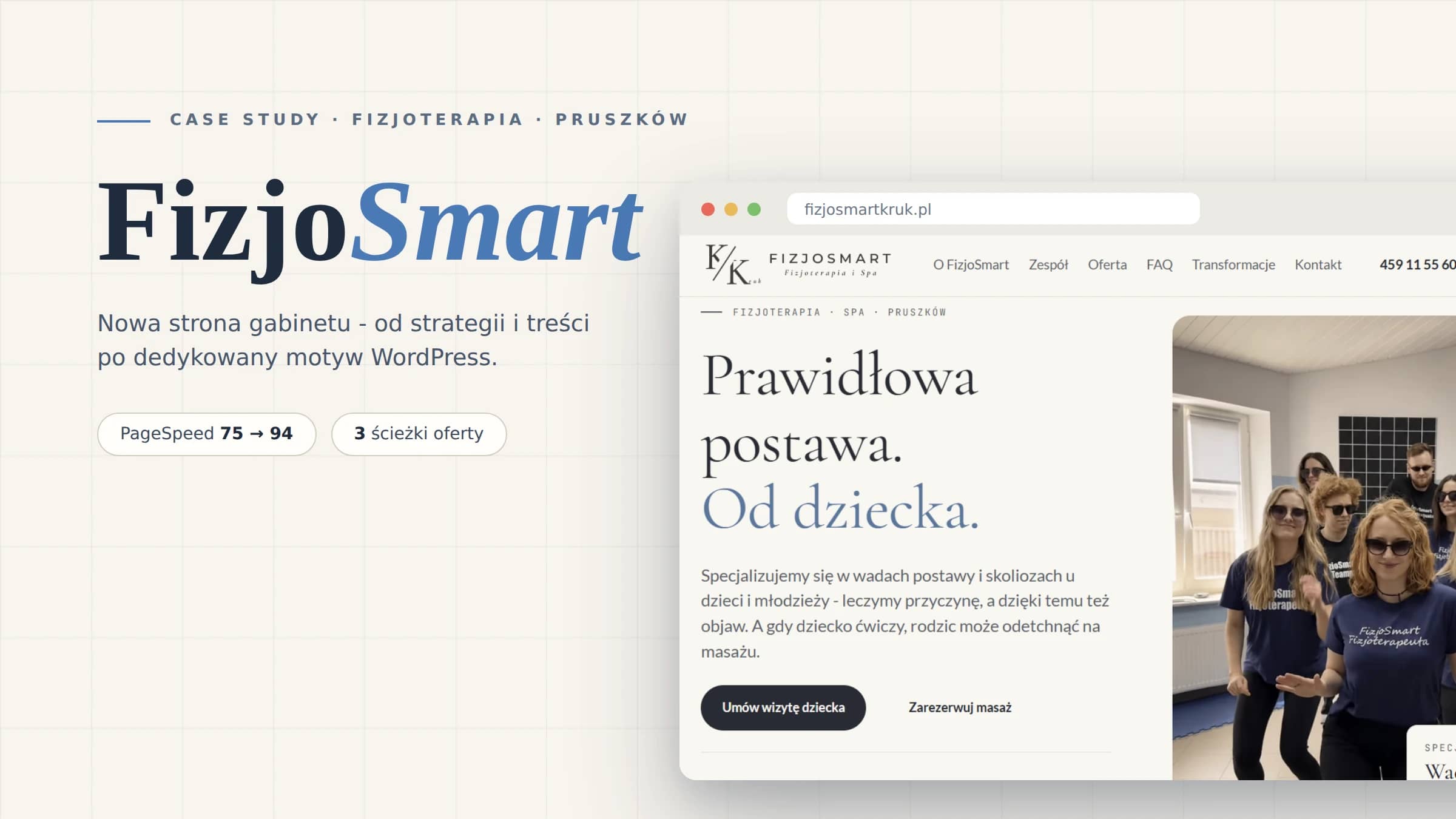
FizjoSmart - 75 → 94 PageSpeed
A new website for a physiotherapy clinic - from content strategy to a custom WordPress theme. Instead of a generic brochure: a clear specialisation from the first screen, three offer paths and prices shown in the context of each service. Mobile PageSpeed went up from 75 to 94.
FAQ
Market ranges are roughly €800-1,600 from a freelancer for a site on a ready-made theme and €3,200-10,000 at an agency for a custom design - they come from contractor price lists, so treat them as an order of magnitude. A custom business website starts at €2,400 with me, with a theme written from scratch and 3 months of care included.
Because you are paying for work and responsibility, not for software. A simple business website adds up to 60-85 hours: architecture and design, coding the views, copy, SEO with schema, testing and deployment. If you see a "WordPress licence" line in a quote, that is a warning sign - WordPress requires no licence.
The fixed minimum is the domain and hosting, together about €80-380 per year according to provider price lists. Technical care is a separate line: updates, backups, monitoring and small fixes - with me from €150 per month for a business website, with the first 3 months included in the build price.
Sometimes it is - when the site only has to confirm the company exists, when you are testing an idea, or when the budget does not exceed €800. The difference becomes significant when the site is meant to win clients from search and AI answers: then content architecture, performance and schema.org start to matter, and those are things a builder gives you limited control over.
A simple business website takes up to 4 weeks with me from the moment the scope is agreed. The timeline grows with a larger scope and - most often - with delays in delivering content, which is why, when comparing offers, it is worth asking directly who writes the copy and what happens to the deadline when it is missing.
Yes, WordPress with WooCommerce is the natural growth path - provided the site has a solid technical base. One important tip: mention such plans at the quoting stage, because the contractor will plan the architecture and theme differently, and the extension will cost less than reworking things after the fact. A good contractor will ask about growth plans themselves.
Summary
The spread in WordPress website prices is a spread in scope, not in margins - from a template with your content dropped in to a theme designed from scratch, these are simply different products. You are paying for decisions, design, coding, copy, SEO and responsibility after launch, not for WordPress, which is free. And a cheap website remains an honest option, as long as you knowingly take a site without those components.
If you have already collected quotes and do not know what to make of them, book a free consultation - bring what you received, and I will tell you how the offers differ and which one fits your situation. Even if none of them is mine.